
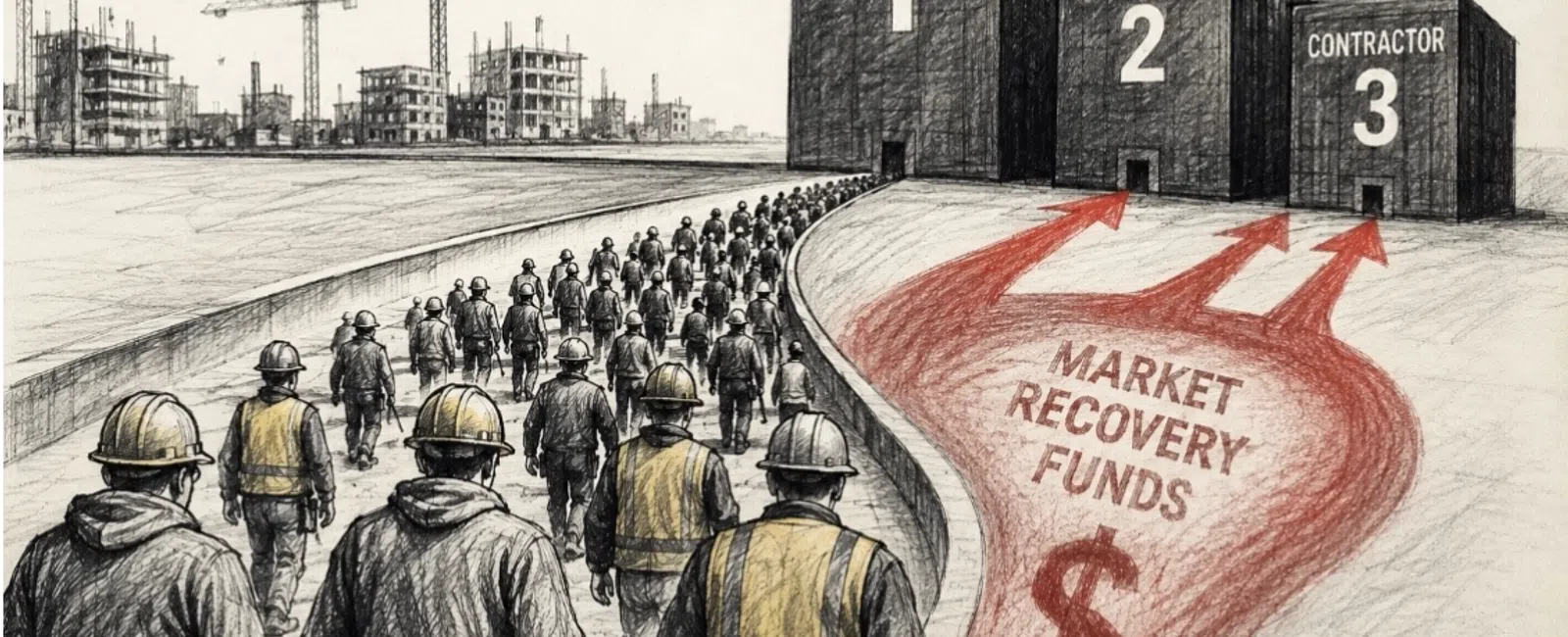
There's an uncomfortable question hanging over a lot of union construction markets right now:
If two or three contractors control most of the work in a jurisdiction, who really has leverage anymore?
A few weeks ago we wrote about monopsony, the inverse of a monopoly where a small number of buyers dominate employment opportunities. In many construction markets, especially in right-to-work states, that isn't theory anymore. It's reality. A handful of contractors control most of the union hours. Most members spend their careers rotating between the same companies. And local unions become increasingly dependent on those contractors to keep members working, keep apprenticeship pipelines healthy, and keep benefit funds solvent.
That changes the relationship between labor and management in ways that aren't always obvious at first.
One place where that tension starts showing up is market recovery funds.
Depending on the trade or region, they may be called target funds, stabilization funds, or market enhancement programs. As you know, the concept is generally the same: labor agrees to subsidize bids on certain projects to help union contractors compete against open-shop competition.
Many members hate the idea on principle. They see it as workers subsidizing contractors who are already making millions of dollars. Others defend it passionately because they've watched entire sectors disappear without it. They'll tell you that without market recovery, union contractors lose private work, apprentices stop getting opportunities, pension hours dry up, and market share collapses.
There is merit in both perspectives.
But monopsony changes the equation.
In a competitive contractor environment, market recovery can function as a strategic tool. The union can use it selectively to expand market share, organize workers, protect key sectors, or help smaller signatory contractors compete against much larger firms. In those situations, recovery programs can actually strengthen the local's leverage by creating a healthier and more competitive contractor ecosystem.
That point matters more than many people realize.
Because market recovery is not simply a labor-versus-contractor issue. It is also a competition issue between contractors themselves.
Large contractors already possess enormous structural advantages: manpower depth, estimating departments, bonding capacity, supplier leverage, financing strength, and longstanding owner relationships. In concentrated markets, those advantages can allow a handful of firms to dominate bidding almost automatically. But when a Local strategically uses recovery funds to help mid-sized signatory contractors compete on larger projects, it can reduce contractor concentration and lessen labor's dependence on the same two or three dominant firms.
In that sense, the structure of market recovery matters just as much as the existence of market recovery.
Because when only a few contractors control most of the work, recovery funds can slowly become something else entirely: an operating assumption that is taken for granted and built into the business model of dominant contractors.
That's where locals should probably start asking harder questions.
If the same handful of contractors receive the overwhelming majority of recovery allocations year after year, is the fund actually increasing union power or simply stabilizing the position of firms that already dominate the market? If labor is subsidizing bids, are the savings truly being passed along to win more work or are portions quietly becoming embedded in contractor profit margins?
Those are uncomfortable questions, but they are not anti-contractor questions. They are simply governance questions. Sustainability questions.
To be fair, business managers are often stuck in an impossible position. They know members need hours. They know pension funds need contributions. They know apprentices need jobsites. They also know that if the local loses too much private market share, the damage may take decades to recover from.
That reality should not be dismissed casually, but neither should locals ignore the long-term risks of dependency.
Because once market recovery becomes permanent, something important changes psychologically inside a union. Contractors stop viewing it as extraordinary assistance and begin viewing it as part of the normal cost structure of union labor. Owners begin expecting it. Estimators begin accounting for it automatically. And eventually labor finds itself subsidizing some of the most financially successful contractors in the region simply to maintain existing market share.
There's another irony hiding inside concentrated construction markets that unions may eventually need to confront honestly.
For generations, organized labor has been able to make a simple argument to nonunion workers: union construction pays more. In many places that may still be true once benefits, retirement, and healthcare in the total roll-up are factored in. But in heavily concentrated union markets, the wage picture itself has become more complicated.
On the open-shop side, there are often dozens or even hundreds of contractors competing aggressively for manpower. As labor shortages intensify, those contractors frequently end up bidding against one another for skilled workers in real time. In some markets, that competition is driving nonunion wages higher, especially on the take-home check.
Meanwhile, in union markets, only a handful of signatory contractors may control most available hours. That concentration can weaken wage pressure in the opposite direction. If dominant contractors know the local depends heavily on them for employment, and if market recovery has become part of the bidding structure, the incentive to aggressively push wages upward can gradually weaken.
The result is a strange inversion: fragmented nonunion markets sometimes push wages upward through competition, while concentrated union markets suppress wage growth through buyer power.
That should concern everyone in the labor movement.
Because once nonunion workers begin believing they can make as much or more outside the union, organizing becomes significantly harder.
At the same time, it is important to acknowledge that not every union market has chosen to respond to competition through formal recovery systems. Some locals, even in difficult right-to-work environments, have remained competitive by focusing heavily on manpower quality, apprenticeship depth, project execution, productivity, and the ability to reliably scale labor on large projects.
That distinction matters.
Because it suggests the long-term goal for organized labor cannot simply be finding better ways to subsidize bids indefinitely. The healthier model may be one where union labor becomes so skilled, reliable, and indispensable that contractors compete for access to the workforce rather than labor competing to reduce its own cost.
That does not mean market recovery has no place. In some jurisdictions it may genuinely be helping preserve union construction in sectors that otherwise would be entirely open shop. But locals should still be asking whether these programs are building long-term worker power or simply helping concentrated contractor markets become even more concentrated.
Because solidarity is not just about keeping members working next month. It's also about making sure the union still has leverage ten years from now.
Let's Talk About Your Local Union
If you've read this far, you know Union Up through our bi-montly newsletter Solidarity Sunday. But did you know that we provide marketing & technology services to local unions across the country? As union members ourselves, we work exclusively with organized labor. Local unions find themselves in a hyper competitive world, and if your Local is not up to the competitive standards of the marketplace, you are losing ground. We want to be your partner in helping you make your local the best it can be. If you need recruiting and organizing help, database management, a lead-generating website, member portal, newsletters to you members, recruiting or training videos, social media strategy, relationships to generate business in the community, or anything that relates to growing your local and putting people to work in your jurisdiction, let's talk.
Schedule a consultation and let's see where we can help you.